
Here's a video of a monk seal sneeze (0:15) at French Frigate Shoals. They are impressive, and hilarious. I suggest turning the volume up!
Sunday, October 3, 2010


Sunday, September 12, 2010

Sunday, June 27, 2010
Photo Update
Lately the days have been going by pretty quickly. The Sooty tern chicks are hatching and the albatross are starting to fledge. Unfortunately we had another pup get bitten by a shark yesterday and the wounds are fatal. Hopefully it dies quickly. In other news we had a strange visitor. A short eared owl has shown up on Tern island, and the other birds don't like it much as they have been giving it a strong hazing. Well that's about it. I decided just to put up a bunch of photos. Hope you enjoy.

A red-tailed tropic bird on Trig island.

The eye of a masked boobie. These loud bastards wake up the seals every time you need to get close to get a tag number, but I still really like them.

A Laysan albatross one day closer to full flight. A monk seal mom and pup rest in the background.
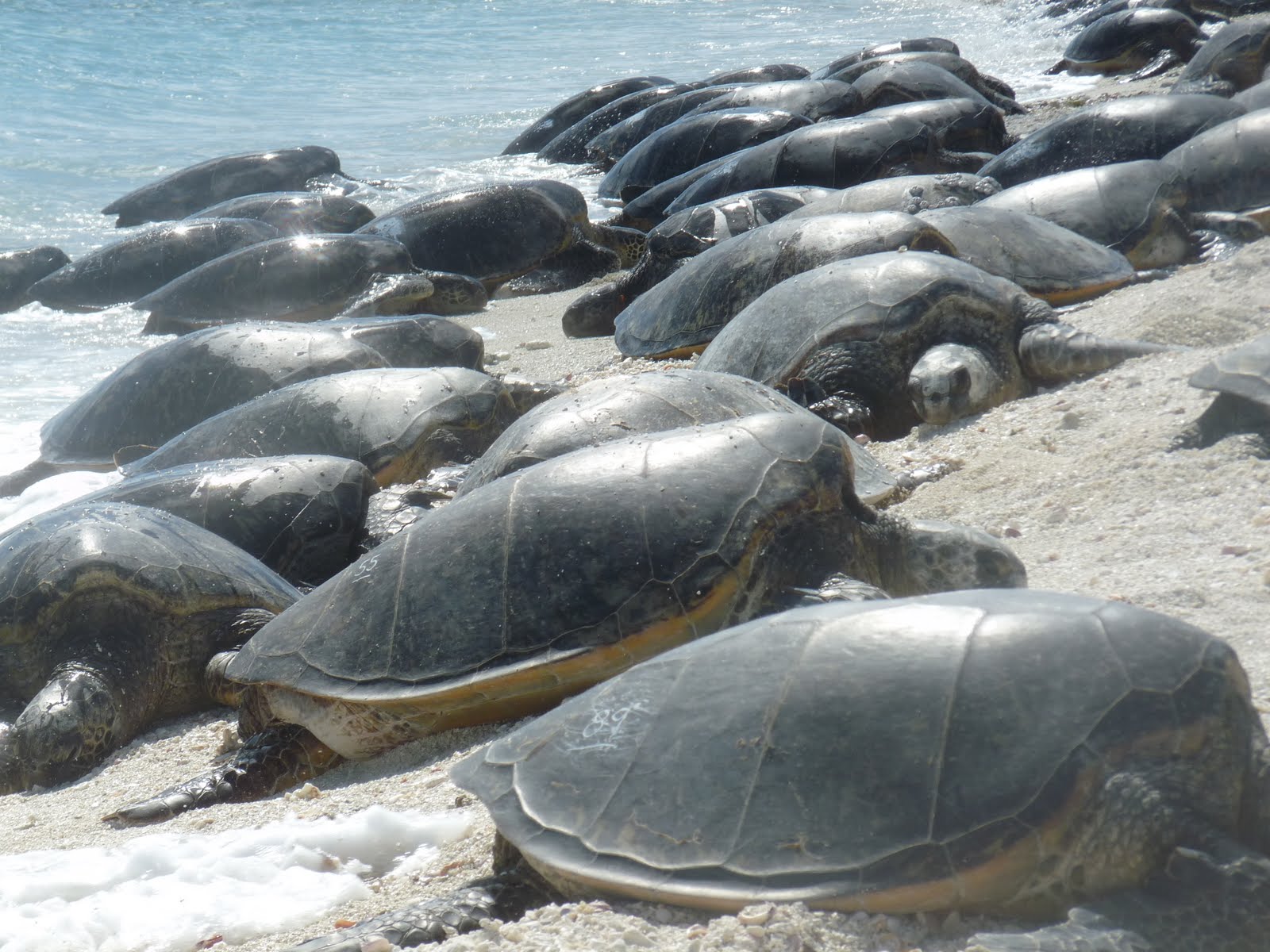
I occasionally forget to photograph the turtles because they tend to get in my way while doing seal surveys, but they really are interesting animals. Here a good size group of green sea turtles is gathered on East island.

Green sea turtles on Trig island.

A white tern on the wing.
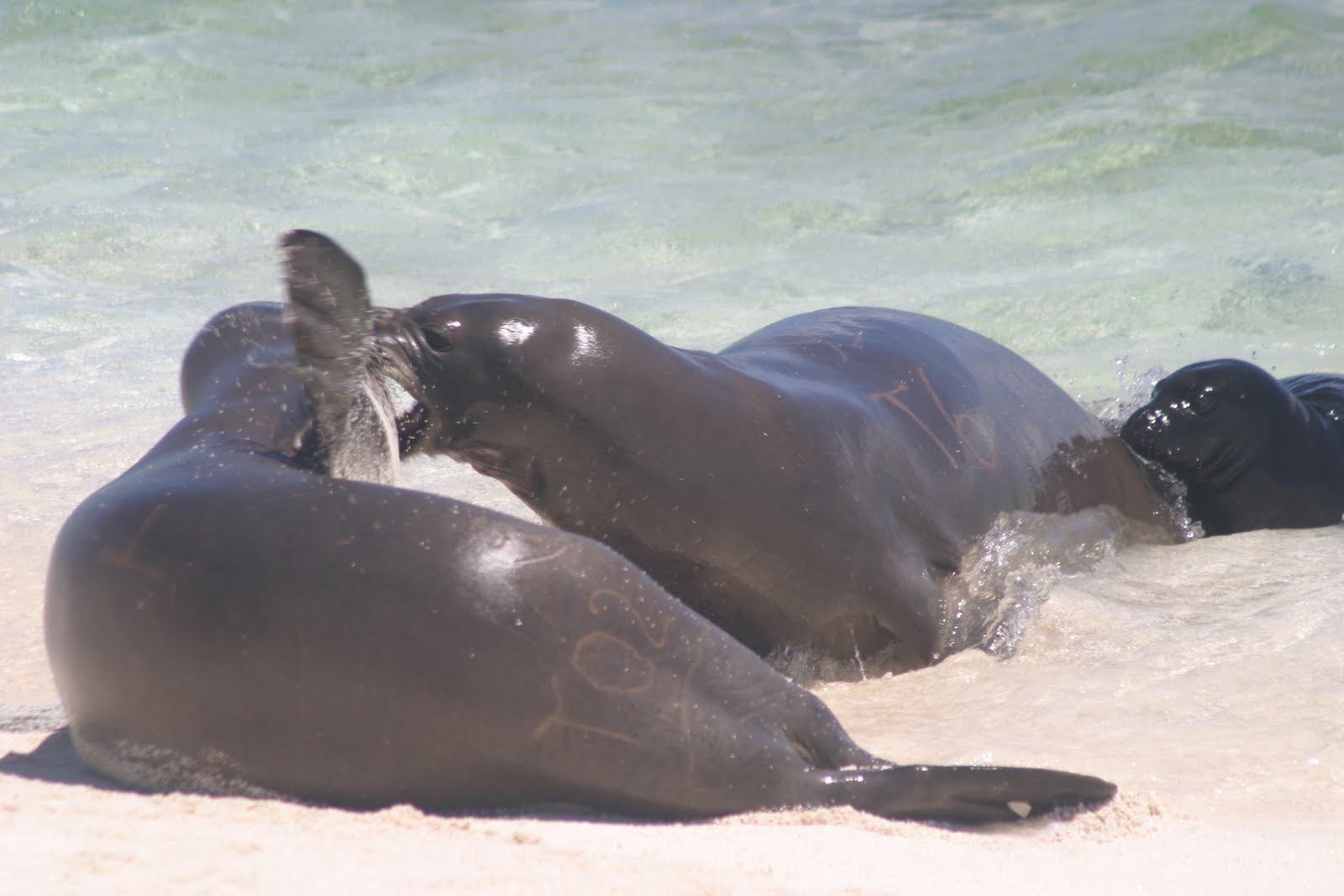
Monk seal moms are strange. They haul out right next to each other then get angry because they are too close. This is more of a mock fight, and no harm was done to either animal. Unfortunately the pup to the right was fatally bitten by a shark yesterday.

A monk seal pup sleeps on its mother.

A short eared owl makes an appearance. It seems to be a little lost.

A sooty tern chick.

This sooty tern chick seems confused about who its mother is. It stands under a black footed albatross who doesn't seem to mind the company.

The lagoon at Little Gin island, and our 17' Boston Whaler.

A male monk seal plotting to wake up all of the females I'm trying to get tag numbers on.

A brown boobie looks on.
Sunday, June 20, 2010
Research At French Frigate Shoals
My plan was initially to post nice photos from French Frigate Shoals, and I will be doing more of that. However, I think it is important to give some background on the research that we are working on while here. The Hawaiian monk seal is federally listed as a critically endangered species; the population is roughly one thousand individuals. The Northwest Hawaiian Islands (NWHI) is habitat for the majority of the population, with French Frigate Shoals being the site of the largest breeding population.
 Figure 1: Map of Hawaiian Archipelago. The area marked as the NWHI are part of the Papahanaumokuakea Marine National Monument (Baker et al. 2010). Please forgive my lack of diacritical usage, I haven't figured out how to do it on the blog writer.
The population at French Frigate Shoals, and in the NWHI as a whole is in steep decline. Although the main Hawaiian Island (MHI) population is currently increasing the overall population has declined by 4%/yr since 2008 when the population was estimated at 1,161 (Baker et al. 2010). In the NWHI the decline is driven by low pup and sub-adult survivability. The cause of high mortality amongst pups and sub-adults is multifaceted, although starvation is a large contributor. Starvation seems counter intuitive on the surface because of the abundance of food in the NWHI, but competition with young seals by top predators such as Ulua, and sharks is thought to drive this mechanism. Other factors include entrapment in marine debris, and shark predation.


The population at French Frigate Shoals, and in the NWHI as a whole is in steep decline. Although the main Hawaiian Island (MHI) population is currently increasing the overall population has declined by 4%/yr since 2008 when the population was estimated at 1,161 (Baker et al. 2010). In the NWHI the decline is driven by low pup and sub-adult survivability. The cause of high mortality amongst pups and sub-adults is multifaceted, although starvation is a large contributor. Starvation seems counter intuitive on the surface because of the abundance of food in the NWHI, but competition with young seals by top predators such as Ulua, and sharks is thought to drive this mechanism. Other factors include entrapment in marine debris, and shark predation.

Figure 2: Survivability curves for 6 NWHI populations represented by solid lines, and MHI population represented by the dotted line (Baker et al. 2010).
Figure 2 demonstrates that the vast majority of seals born in the NWHI do not survive to four years of age. This problem compounds survivability problems because the monk seals in the NWHI do not reach reproductive age until after the age of four.

Figure 3: Female monk seal size by age. FFS-French Frigate Shoals, LAY-Laysan Island, LIS-Lisianski Island, PMK-Pearl and Hermes Midway and Kure combined, MHI-Main Hawaiian Islands (Baker et al. 2010).
In the NWHI low sub-adult survivability (fig. 2) and a slow growth rate to sexual maturity (fig. 3) place the Hawaiian monk seal on the razors edge of extinction, and give little reassurance for the future of the species. A tentative glimmer of hope for the population lies in increases in the NWHI at Laysan Island, and a general trend towards growth in the MHI. However, this view must be tempered with the reality that the population is extremely similar genetically meaning that other factors, specifically disease, could quickly destroy all progress on these fronts.

A yearling monk seal has lost the fat layer from mothers milk and must learn to forage well or starve.

A monk seal pup with a fatal shark bite likely from a Galapagos shark. She died two days ago.
Baker J.D., Harting A.L., Wurth T.A., Johanos T.C. 2010. Dramatic shifts in Hawaiian monk seal distribution
predicted from divergent regional trends. Marine Mammal Science. DOI:10.1111/j.1748-7692.2010.00395.x
predicted from divergent regional trends. Marine Mammal Science. DOI:10.1111/j.1748-7692.2010.00395.x
All photos by Darren Roberts.
As a sidenote, I pulled strongly from one paper and personal knowledge due to lack of resources out here, as well as the fact that Baker et al. 2010 is up to date concerning a dynamic population.
Sunday, June 6, 2010
Lost and Found
I arrived at French Frigate Shoals a couple of weeks ago now. As I get settled in I will be posting updates on our research here, and just general fun photos and things.
As of right now, I'm not sure how fast pictures are going to upload so I will use this blog to put up a couple photos so I can get an idea of how in depth this blog can be while I am out here. I will right more about the actual research in future updates.
Here are some photos from the first couple of weeks.
 Mark, a member of the monk seal team, walks to the tractor shed. Population is about at 10 now, getting big!
There are loads of great birds out on Tern, I think my favorite so far are the boobies and the albatross.
 A red footed boobie on Tern island.
 Two Laysan albatross
 A great frigate chick, doing what they do.
 A great frigate during a Tern island sunset.
Well this blog is just test to see what the upload time is like. If everything goes well on this end I will post more photos with more in depth information on the research and general biology of the area. Hope you enjoy.
As of right now, I'm not sure how fast pictures are going to upload so I will use this blog to put up a couple photos so I can get an idea of how in depth this blog can be while I am out here. I will right more about the actual research in future updates.
Here are some photos from the first couple of weeks.

There are loads of great birds out on Tern, I think my favorite so far are the boobies and the albatross.


Well this blog is just test to see what the upload time is like. If everything goes well on this end I will post more photos with more in depth information on the research and general biology of the area. Hope you enjoy.
Saturday, May 15, 2010
Trip to Nihoa
After a month of training and not blogging much we are finally underway to the Northwest Hawaiian Islands on board the NOAA vessel Oscar Elton Sette. We left Pearl Harbor Thursday the 13th in route to Nihoa island.
 NOAA Vessel Oscar Elton Sette

 Nihoa from the ship
At Nihoa a team was put ashore to photograph seals, as well as look for any pups. The science team was able to find 27 seals before being called off the island. While the team was ashore I photographed birds from the ship. Nihoa is a highly active nesting island for many birds. There were a lot of birds foraging around Nihoa; sightings for the day included wedge tailed sheerwaters, Bulwer's petrels, blue-grey noddies, sooty terns, red footed boobies, brown boobies, masked boobies, white terns, red tailed tropic birds, and great frigates.

 Masked boobies
 Two female great frigate birds from the Sette
Operations on Nihoa were called off early due to a medical emergency aboard the ship. We brought the team back to the ship, and set course for Kauai. The navy was involved in active training in the Barking sands training area. A helicopter evacuation of the patient was arranged by the navy due to their proximity to our ship. A navy destroyer approached at a distance and deployed a SH-60B helicopter to attempt a rescue, in turn a C-130 airplane circled the ship assessing the scene. The afterdeck of the Sette is unusually cluttered due to the amount of scientific equipment aboard so the rescue was attempted from the bow. The bow of the ship proved to be a small target given the conditions. The SH-60 struggled to get the rescue swimmer on the deck of the ship for nearly 2 hours. At that point it was decided to cancel the helicopter rescue. Several hours later a second attempt was made by the US Coast Guard using the H-65 "Dolphin" helicopter. This attempt was successful even though winds had reached 27 knots, with rain, and building seas. The Coast Guard had a swimmer on board to set up the rescue litter, and had evacuated the patient within 30 minutes. It was very impressive to watch these professionals work. The USCG did a fantastic job, working with almost surgical precision.
 SH-60B "Sea Hawk"
 H-65 "Dolphin"
 Bow of the Oscar Elton Sette
After the successful rescue operation, we set course for Pearl Harbor to pick up a new crew member so that the ship is at operating capacity in regards to crew. We will be heading back to sea on Monday.
Oscar Elton Sette photo credit: http://www.moc.noaa.gov/os/
Helicopter photo credit:
SH-60: http://www.navysite.de/planes/sh60.htm
H-65: http://www.uscg.mil/datasheet/hh-65.asp


At Nihoa a team was put ashore to photograph seals, as well as look for any pups. The science team was able to find 27 seals before being called off the island. While the team was ashore I photographed birds from the ship. Nihoa is a highly active nesting island for many birds. There were a lot of birds foraging around Nihoa; sightings for the day included wedge tailed sheerwaters, Bulwer's petrels, blue-grey noddies, sooty terns, red footed boobies, brown boobies, masked boobies, white terns, red tailed tropic birds, and great frigates.


Operations on Nihoa were called off early due to a medical emergency aboard the ship. We brought the team back to the ship, and set course for Kauai. The navy was involved in active training in the Barking sands training area. A helicopter evacuation of the patient was arranged by the navy due to their proximity to our ship. A navy destroyer approached at a distance and deployed a SH-60B helicopter to attempt a rescue, in turn a C-130 airplane circled the ship assessing the scene. The afterdeck of the Sette is unusually cluttered due to the amount of scientific equipment aboard so the rescue was attempted from the bow. The bow of the ship proved to be a small target given the conditions. The SH-60 struggled to get the rescue swimmer on the deck of the ship for nearly 2 hours. At that point it was decided to cancel the helicopter rescue. Several hours later a second attempt was made by the US Coast Guard using the H-65 "Dolphin" helicopter. This attempt was successful even though winds had reached 27 knots, with rain, and building seas. The Coast Guard had a swimmer on board to set up the rescue litter, and had evacuated the patient within 30 minutes. It was very impressive to watch these professionals work. The USCG did a fantastic job, working with almost surgical precision.


After the successful rescue operation, we set course for Pearl Harbor to pick up a new crew member so that the ship is at operating capacity in regards to crew. We will be heading back to sea on Monday.
Oscar Elton Sette photo credit: http://www.moc.noaa.gov/os/
Helicopter photo credit:
SH-60: http://www.navysite.de/planes/sh60.htm
H-65: http://www.uscg.mil/datasheet/hh-65.asp
Saturday, April 17, 2010
Bird of the Week
The superb lyrebird (Menura novaehollandiae) might win the prize for the coolest bird ever. This is a must watch!
Sunday, April 4, 2010
Isopod Update
I linked to an article about the giant isopod (Bathynomus giganteus). The article was incorrect on several issues, and the most prominent mistake from that post was with the supposed size (I didn't check the literature, I assumed the author had done so. Sorry for the bad information). A quote from a worker on deck suggested that the specimen was over 2.5 ft long. Published literature places the average length at ~0.9-1.2ft, and MacAvoy et al. 2002 claims the largest specimen in collection is ~1.6ft. It is possible that this specimen is the largest ever seen, but it is more likely that the guy on deck overestimated the size. For a fantastic article that corrects many of the mistakes circulating in the main stream media about this creature check out the Deep Sea News blog.


- MacAvoy, S. E., R. S. Carney, C. R. Fisher, and S. A. Macko. 2002. Use of chemosynthetic biomass by large, mobile, benthic predators in the Gulf of Mexico. Marine Ecology Progress Series 225:65-78
Friday, April 2, 2010
Capsize Guam!?
Rep. Hank Johnson (D-GA) apparently thinks that Guam is in danger of capsizing! Really? Really?
Credit Where Credit Is Due
ABC has released an article on a young girl who was apparently saved by a miracle of god. In 1987 Benedicta McCarthy a two year old from Boston got into her parents medicine supply and ingested 19 times the lethal dose of acetaminophen. When she arrived at the hospital the physicians did not think this case would have a positive outcome, however due to a kidney transplant and immediate help from physicians it did have a positive out come. The Vatican and McCarthy now 25 believes it was a miracle from heaven. I would be more inclined to think it was the work of a talented group of physicians trained in science based medicine using state of the art technology that saved her life and not that magical bullshit.
The thing that really amazes me about this article, and really pisses me off about these overzealous religious cooks is that she thanks god and the saints but completely fails to recognize those critical to her survival. How about the doctors who performed the kidney transplant that saved your life! How about the donor that provided that kidney. But no, the modern science that saved McCarthy's life is pushed to the side so the Catholic church can sit high and take credit for things which they had no part in.
The kicker to me is the part where the family was so amazed how fast she felt better. Well she got a new kidney, and guess what those things start working pretty damn fast once they're in! The family didn't know that a new kidney will make a person feel a lot better quickly and so they assumed it was gods work, that is just an argument out of ignorance. I am disappointed that ABC would put out an article that is so one sided without even a hint of looking at what really happened.
If Ms. McCarthy wants to give credit to saints and angels that's fine, but maybe she could put them down on the list a little, and maybe give some credit where credit is due.
Thursday, April 1, 2010
Thursday Isopod


This Giant isopod (Bathynomus giganteus) attached to an ROV at roughly 8,500 ft. It is just over 2.5 feet from head to tail, and it is one crazy looking bastard. Click here to see the full article.
Tuesday, March 30, 2010
Tuesday, March 9, 2010
Christopher Hitchens: Variation On A Theme
My kind of ten commandments. This one comes courtesy of Stupid Evil Bastard.
Wednesday, December 30, 2009
The Virgin Damaged My Macula!
Ireland's Knock shrine is well known for apparent divine visions of the virgin Mary and other sacred figures. The shrine, and the visions associated with it are considered by the catholic church to be trustworthy1. These 'miracles' attract over 1.5 million visitors annually making the Knock shrine the most popular attraction in western Ireland1. In late October an apparition of the virgin 'appeared' in the skies over the shrine.
About 10,000 people attended a supposed apparition of the Virgin Mary at the Knock shrine in Co Mayo on October 31st. At this, and at a similar event on October 11th, people claimed to see the sun shimmering, changing colour and “dancing in the sky”.
This 'miracle' turns out to be a public health concern. Dr. Eamonn O’Donoghue, an ophthalmologist surgeon in Galway has seen a five fold increase in cases of solar retinopathy. A condition caused by staring at the sun that can lead to blindness.
Solar retinopathy, or eclipse retinopathy as it is also known, affects the macula and can cause a significant reduction in vision. It can also lead to altered images, altered colour perception and blind spots.
1: http://www.sacred-destinations.com/ireland/knock-shrine
All quotes are from the Irish Times.
Also see:
The Irish Times article about the health concern.
The Skeptics Guide To The Universe podcast
The Bad Astronomer, Phil Plait
About 10,000 people attended a supposed apparition of the Virgin Mary at the Knock shrine in Co Mayo on October 31st. At this, and at a similar event on October 11th, people claimed to see the sun shimmering, changing colour and “dancing in the sky”.
This 'miracle' turns out to be a public health concern. Dr. Eamonn O’Donoghue, an ophthalmologist surgeon in Galway has seen a five fold increase in cases of solar retinopathy. A condition caused by staring at the sun that can lead to blindness.
Solar retinopathy, or eclipse retinopathy as it is also known, affects the macula and can cause a significant reduction in vision. It can also lead to altered images, altered colour perception and blind spots.
Miracles seem less and less miraculous the closer we look. In this case the affect was negative. If it were a corporation they would have been sued for something like this. Perhaps the church will be, but I doubt it.
1: http://www.sacred-destinations.com/ireland/knock-shrine
All quotes are from the Irish Times.
Also see:
The Irish Times article about the health concern.
The Skeptics Guide To The Universe podcast
The Bad Astronomer, Phil Plait
Friday, December 18, 2009
Time Magazine: A Volcano in the Philippines Awakens

Mayon volcano is located near Legazpi City on the island of Luzon in the Philippines. On December 16th some 78 earthquakes were recorded on the island. By December 17th the province was declared in a state of imminent disaster. This photo essay by Dennis M. Sabangan published in Time Magazine helps tell the story, and has excellent photos: A Volcano in the Philippines Awakens.
Photo from: http://geology.com/news/images/mayon-volcano-image.jpg

Hominid you just see that?
The fossil remains of Ardipithecus ramidus provide fascinating insight into the evolution of early hominids. In the years following the discovery of Ar. ramidus in 1992 a new understanding of early hominid evolution has been formed. Specifically Ar. ramidus falsifies the hypothesis that the earliest hominids evolved on the savanna. Ar. ramidus also tells us that hominid evolution has been in the works for nearly 6 million years. The work of scientists studying Ar. ramidus has been heralded as the scientific breakthrough of the year for 2009 by Science Magazine, and this video is a nice update on the current understanding of the early hominids.
http://www.sciencemag.org/cgi/content/full/326/5960/1598-b
http://www.sciencemag.org/cgi/content/full/326/5960/1598-b
Wednesday, December 16, 2009
Crazy Extremists!
I found this unfortunate song from the lunatics at the Westboro baptist church. A great reminder that extremism in all forms is, well stupid. Although the message is horrible and the people are insane, I must say, I laughed pretty hard at how ridiculous this song and these folks are. The unfortunate part is the little girl at the end...
Tuesday, December 15, 2009
Bird of the Week
The White Tern (Gygis alba) nests in tropical and subtropical coastal regions worldwide. This species is well known for laying a single egg placed precociously in a tree, on a rock, or even on buildings1. The White Tern does not build a tree nest like the related Black Noddy (Anous minutus), or a ground nest like the Sooty Tern (Sterna fuscata). The variability in nesting strategies is possibly my favorite aspect of this group (subfamily Sterninae).
The lack of a nest may seem like a haphazard way to hatch an egg, but the White Tern has adaptations that make this a fitting strategy. For example the White Tern takes a relatively short amount of time after each failed egg before it lays another allowing it to lay multiple eggs in quick succession1. Having no nest also removes the risk of brood parasites. The White Tern reduces it's molting time, which increases the length of the nesting season, by replacing it's feathers in waves1.


Photos by Forest and Kim Starr
For more information visit:
http://bna.birds.cornell.edu/bna/species/371/articles/introduction
http://www.hear.org/starr/birds/images/species/?q=gygis+alba
http://www.state.hi.us/dlnr/dofaw/cwcs/files/NAAT%20final%20CWCS/Chapters/Terrestrial%20Fact%20Sheets/Seabirds/White%20fairy%20tern%20NAAT%20final%20!.pdf
1. Niethammer, Kenneth R. and Laura B. Patrick. 1998. White Tern (Gygis alba), The Birds of North America Online (A. Poole, Ed.). Ithaca: Cornell Lab of Ornithology; Retrieved from the Birds of North America Online: http://bna.birds.cornell.edu/bna/species/371 doi:10.2173/bna.371
All taxonomy from itis.gov
Interesting Lecture. Interesting intro music.
Here it is, blog number one. I will be posting things that I find interesting with occasional commentary. Here is a nice lecture summarizing some of the evidence regarding evolution. Dr. Prothero, an Occidental College paleontologist and geologist, reviews evolutionary theory with examples from the fossil record as well as examples from molecular biology. He also addresses the creationist attack on evolutionary biology and science in general. Although the intro music is awful, the lecture itself is well put together. Enjoy!
Subscribe to:
Posts (Atom)